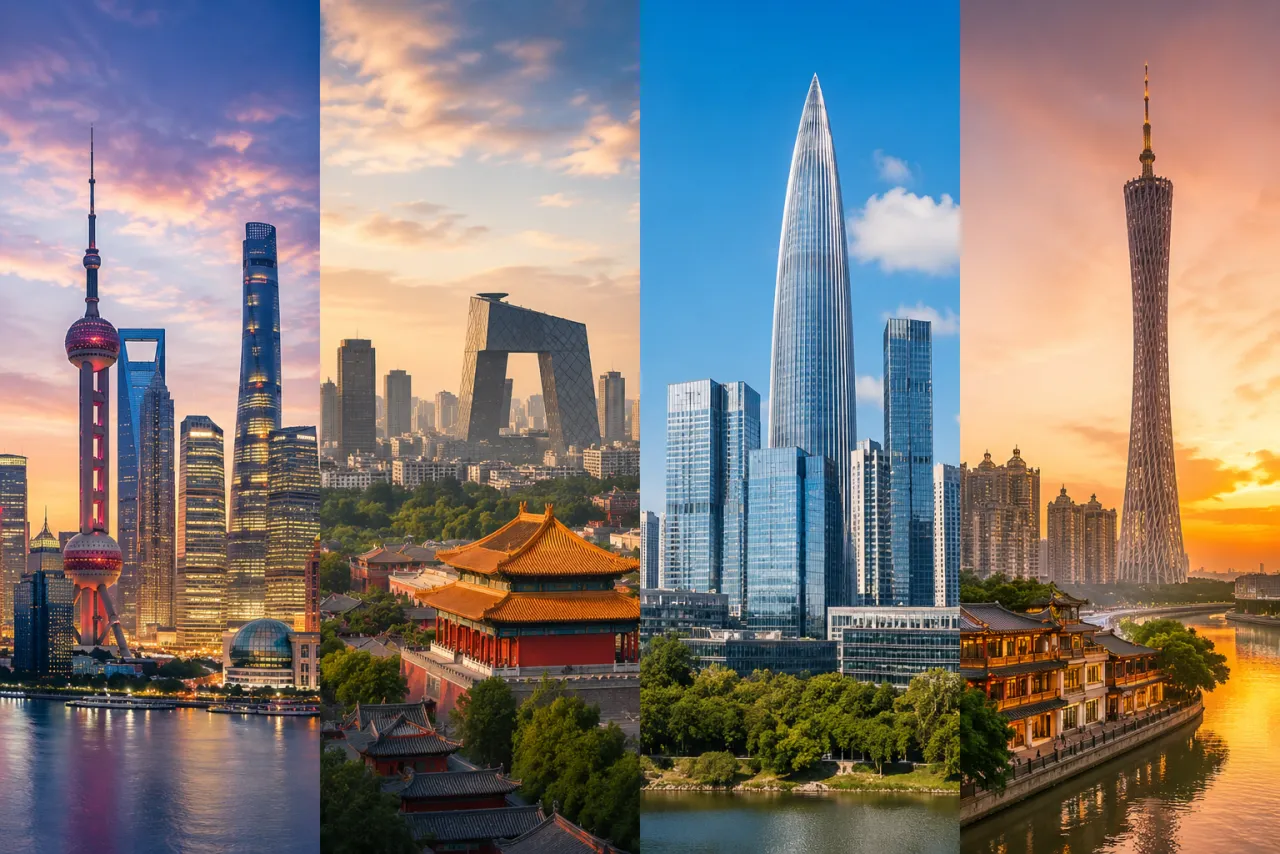
The short answer: for most foreigners, Shanghai is the best city to live in China — it has the largest expat community, the strongest international infrastructure, and the easiest soft landing. Beijing suits careers in culture, education, and policy; Shenzhen is unmatched for tech; Guangzhou wins on cost of living. The right choice depends on your career, budget, and tolerance for climate and crowds.
China’s four Tier-1 cities — Beijing, Shanghai, Shenzhen, and Guangzhou — are the country’s wealthiest, most internationally connected, and most expensive urban centers. Each offers a distinct lifestyle shaped by history, industry, and culture. For anyone considering a move, understanding their unique trade-offs is essential.
Already living in one of these cities? Choosing where to live is the easy part. Staying there legally is where people need help: renewing a China residence permit, changing it after a new job or a marriage, or checking whether you now qualify for permanent residence (the China green card).
Shanghai: the international cosmopolitan
Shanghai is China’s commercial capital and most globally integrated city. It boasts the largest expat community and strongest job market for finance, trade, luxury goods, and professional services.
Pros: The city offers unparalleled international infrastructure — Western restaurants, English-language medical facilities, international schools, and a vibrant social scene. The French Concession neighborhood, with its tree-lined streets and cafes, feels genuinely different from anywhere else in China. The safety is exceptional, with violent crime virtually non-existent. The convenience is unmatched, with 24/7 delivery apps and cashless mobile payments making daily life hyper-efficient.
Cons: Shanghai is the most expensive city in mainland China. A one-bedroom apartment in the city center averages about ¥6,371 (roughly $950) a month, on the Numbeo figures in our cost of living breakdown. Summer heat is intense — temperatures often exceed 35°C with high humidity. The Great Firewall blocks many Western websites and apps, requiring VPNs. Crowds are relentless in a city of 25 million people.
Beijing: the political and cultural heart
As China’s capital (on and off) for over 3,000 years, Beijing carries historical weight that Shanghai cannot replicate. The Forbidden City, Summer Palace, Temple of Heaven, and Great Wall are part of daily life rather than tourist destinations.
Pros: Beijing is strong for technology, education, government-adjacent roles, and media. Zhongguancun district is known as “China’s Silicon Valley,” home to ByteDance, Baidu, and Meituan. It offers rich cultural immersion and access to China’s most prestigious universities and state institutions. The expat community is large, though skewed toward academics, journalists, and diplomats.
Cons: Air quality remains a genuine health concern. Despite significant improvements (average PM2.5 of 28.5 µg/m³ in 2025), seasonal smog and sandstorms persist. Winters are brutally cold, dropping below -10°C, while summers are hot and humid. The “996” work culture (9am–9pm, six days a week) is prevalent in domestic tech giants, leading to poor work-life balance. Mandarin is essential — unlike Shanghai, English proficiency among locals is limited. The expat community has shrunk since COVID, reducing the cosmopolitan vibe.
Shenzhen: the innovation powerhouse
Forty years ago a fishing village of 30,000 people, Shenzhen is now a city of over 17 million and China’s technology and innovation capital, home to Huawei, Tencent, DJI, and BYD.
Pros: For tech professionals, Shenzhen offers exceptional opportunities in software engineering, hardware development, AI, and telecommunications. Its border location with Hong Kong gives it a more international business culture and greater English proficiency among professionals. The city feels young, forward-looking, and modern, with well-maintained infrastructure.
Cons: Shenzhen’s cost of living has risen dramatically. Day-to-day costs for a single person now sit close to Shanghai’s, at about ¥4,072 a month before rent against ¥4,179, although a downtown one-bedroom is still cheaper, at about ¥5,136 against ¥6,371. The city lacks the historical depth of Beijing or the cosmopolitan refinement of Shanghai. The jobs-housing imbalance is acute — many workers face long commutes from suburban areas to job-rich urban cores. The tech-driven culture can be intense, with high expectations and limited work-life balance.
Guangzhou: the understated southern metropolis
Often overlooked in favor of its flashier peers, Guangzhou offers a more balanced and affordable Tier-1 experience while remaining a major economic hub.
Pros: Guangzhou has the lowest cost of living among the four Tier-1 cities. Average monthly rent for a one-bedroom in the city center is about ¥3,611 (roughly $540), compared to ¥6,371 in Shanghai and ¥5,136 in Shenzhen. The city is known for its legendary Cantonese cuisine and a more laid-back, trade-oriented commercial culture. It serves as a major manufacturing and trade hub, with strong connections to Southeast Asia.
Cons: Guangzhou lacks the international prestige and expat infrastructure of Shanghai and Beijing. While the expat community exists, it is smaller and less internationally diverse. Job opportunities are less abundant in high-end finance and tech compared to the other three cities. The summer heat and humidity are intense, and air quality, while improved, still poses concerns.
So what’s the best place to live in China?
| City | Best For | Biggest Drawback |
|---|---|---|
| Shanghai | International careers, finance, cosmopolitan lifestyle | Highest cost (~¥10,550/mo for a single person), intense summer heat |
| Beijing | Culture, technology, government roles | Air quality, harsh winters, limited English |
| Shenzhen | Tech professionals, innovation, entrepreneurs | High cost (~¥9,200/mo for a single person), limited history, intense work culture |
| Guangzhou | Affordability, food, trade | Smaller expat community, fewer international jobs |
The choice ultimately depends on your career, budget, and tolerance for crowds, climate, and language barriers. Shanghai offers the most accessible transition but at the highest cost. Beijing rewards those who embrace its intensity. Shenzhen is unmatched for tech careers but at a lifestyle cost. Guangzhou provides the best value for those willing to trade prestige for affordability.
Whichever city you choose, living there long-term means holding the right immigration status. Start with the difference between temporary and permanent residence, then see our plain-English guides to the residence permit and Chinese permanent residence (the “Green Card”). If you are moving to retire rather than to work, start instead with how a foreigner can retire in China. And once you have an address in your chosen city, you have 24 hours to register it with the police, which can now be done online.
Frequently asked questions
- What are China's Tier-1 cities?
- China's four Tier-1 cities are Beijing, Shanghai, Shenzhen, and Guangzhou. Tier-1 is an informal classification based on economic scale, population, and international connectivity, and these four are the country's wealthiest, most internationally connected, and most expensive urban centers. They differ sharply in daily life: Shanghai has the largest expat community, Beijing suits culture and policy careers, Shenzhen is the tech hub, and Guangzhou is the cheapest of the four.
- Is Shenzhen a Tier-1 city?
- Yes. Shenzhen is one of China's four Tier-1 cities, alongside Shanghai, Beijing, and Guangzhou. Of the four it is the technology hub, home to Huawei, Tencent, DJI, and BYD. Day-to-day costs there now sit close to Shanghai's, though a downtown one-bedroom is cheaper, at about ¥5,136 a month against ¥6,371, on Numbeo's August 2026 figures.
- What tier is Guangzhou?
- Guangzhou is a Tier-1 city, one of China's four alongside Shanghai, Beijing, and Shenzhen. It is the cheapest of the four to live in, and the trade-off is a smaller expat community and fewer international jobs than Shanghai or Beijing offer.
- What is the best place to live in China for foreigners?
- For most foreigners the best place to live in China is Shanghai — it has the largest expat community, the most English-friendly services, and the widest job market. If budget matters more, Guangzhou is the cheapest Tier-1 city; Beijing suits culture and policy careers, and Shenzhen suits tech.
- What is the best city to live in China as a foreigner?
- For most foreigners, Shanghai is the best all-around choice: it has China's largest expat community, the strongest international infrastructure (English-speaking hospitals, international schools), and the widest job market. Beijing is better for culture, education, and policy careers, Shenzhen for tech, and Guangzhou for a lower cost of living.
- Which Tier-1 city in China is the cheapest to live in?
- Guangzhou. A one-bedroom apartment downtown runs about ¥3,611 (roughly $540) a month, against ¥6,371 in Shanghai and ¥5,136 in Shenzhen, on Numbeo's August 2026 figures.
- Is China a good place to live for expats?
- For many expats, yes: exceptional public safety, world-class transport and delivery infrastructure, and a lower cost of living than comparable Western cities. The main trade-offs are the language barrier, internet restrictions that require a VPN, and air quality in some northern cities.
- Do I need a visa or residence permit to live in a Chinese city long-term?
- Yes. Staying more than 180 days requires a residence permit tied to work, study, or family. Long-term residents who meet investment, employment, or family criteria can eventually apply for Chinese permanent residence (the 'Chinese Green Card').
Which route actually fits you?
Work, family, study, investment and permanent residence each carry conditions that are easy to miss until the year they matter. Tell us where you are now and we will tell you plainly which one applies.
Tell us your situation